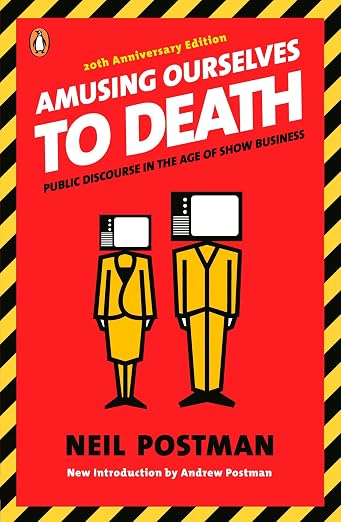
Amusing Ourselves to Death
Public Discourse in the Age of Show Business
Neil Postman
1985
A study of media, public discourse, and what happens when entertainment becomes the dominant way a culture understands the world.
Published in 1985, Amusing Ourselves to Death examines how television transformed public discourse in the United States. Postman’s argument is not simply that television contains too much entertainment. His deeper concern is that the form of a medium influences the kinds of ideas that can be communicated through it, and consequently the ways in which a culture thinks.
Drawing on the earlier transition from print-based public discourse to television, Postman examines politics, journalism, education, advertising, and religion as examples of how serious subjects can be transformed when they must conform to the demands of an entertainment medium. When everything must compete for attention, complexity, context, and sustained argument can become increasingly difficult to sustain.
The book is particularly relevant to DCRU because it asks us to look beyond the content delivered by technology and examine the environment created by the technology itself. A medium does not simply carry information from one person to another. It can influence what kind of information are produced, how they are presented, what people pay attention to, and what they come to recognise as meaningful knowledge.
The technologies have changed since the book was published. Television is no longer the only dominant medium, and the information environment Postman encountered has been transformed by the Internet, social media, smartphones, and algorithmic systems.
The underlying question, however, remains useful:
What happens to a culture when the medium through which it understands the world rewards entertainment above understanding?
Amusing Ourselves to Death is included in the DCRU library as an early and influential examination of the relationship between media, attention, knowledge, and culture.