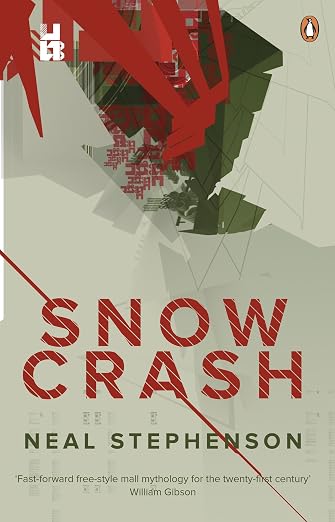
Snow Crash
Neal Stephenson
1992
A science-fiction novel about the Metaverse, digital identity, network, language, and the fragmentation of society in a technologically saturated world.
Published in 1992, Snow Crash follows Hiro Protagonist, a hacker, and pizza delivery driver living in a fragmented near-future America where governments have weakened, corporations and private organisations control much of everyday life, and people increasingly move between physical and digital worlds.
At the centre of the novel is the Metaverse, a persistent virtual environment where people interact through avatars, socialise, work, conduct business, and establish identities separate from their physical lives. Stephenson’s imagined network is not simply a communication system. It is a place where society happens.
The Metaverse is one of the novel’s most enduring ideas, and the term itself later become widely associated with visions of persistent virtual worlds. But Snow Crash is interesting for more than coining a word. Stephenson was imagining what happens when digital spaces develop their own cultures, economies, identities, communities, and hierarchies.
The novel also presents a society in which traditional institutions have fragmented. Governments coexist with corporations, privately controlled infrastructure. Technology does not simply sit alongside society; it becomes entangled with the structures through which society operates.
Language is another important thread. The mysterious “snow crash” virus connects computing, language, cognition, and human behaviour, allowing Stephenson to explore the possibility that information system might operate at a level deeper that the machines that carry them. The novel treats language itself as a kind of technology: something capable of shaping how humans understand and interact with the world.
The novel should not be treated as a literal prediction of the Internet or the Metaverse. Some of its technological visions have aged, while others have taken very different forms from those Stephenson imagined. Its lasting value lies less in prediction than in the questions it raises.
What happens when a digital space becomes a place rather than merely a tool? What happens when identity can exist simultaneously in physical and virtual worlds? And what happens to society when the infrastructure through which people live can be privately owned, fragmented and governed by different rules?
Snow Crash is included in the DCRU library as an important work of speculative fiction about networked culture, digital identity, virtual worlds, language, and the relationship between technology and social organisation.
The Metaverse may have been fictional when Stephenson wrote about it. The question is what happens when the fictional space begins to resemble the world around us.