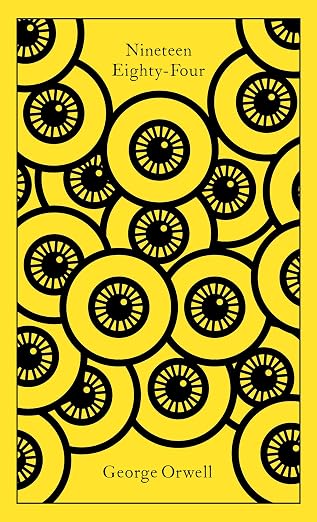
Nineteen Eighty-Four
George Orwell
1949
A dystopian novel about surveillance, propaganda, language, and the struggle to preserve individual thought
Published in 1949, Nineteen Eight-Four imagines a society in which the state exercises pervasive control over information, language, behaviour, and private life. Citizens are continuously watched, historical records are rewritten, and political power extends beyond controlling what people do to controlling what they are permitted to think.
At the center of the novel is the idea that control over information can become control over reality itself. The Ministry of Truth continually alters the historical record, while Newspeak attempts to reduce the range of thought by reducing the language available to express it. Truth becomes something that can be revised according to the needs of the state, while surveillance makes privacy increasingly impossible.
This makes Nineteen Eighty-Four particularly relevant to DCRU. The technologies of Orwell’s world may belong to another era, but the questions surrounding them remain important: Who controls information? Who decides what becomes part of the historical record? What happens to privacy when observation becomes pervasive? And what happens to individual judgement when the systems around us increasingly determine what information we encounter?
The novel should now be treated as literal prediction of the digital age. Its value lies instead in the conceptual tools it gives us for examine power, information, surveillance, language, and the relationship between technology and human autonomy.
Nineteen Eight-Four is included in the DCRU library because it remains one of the most influential fictional examinations of what can happen when the control of information becomes inseparable from control of people.