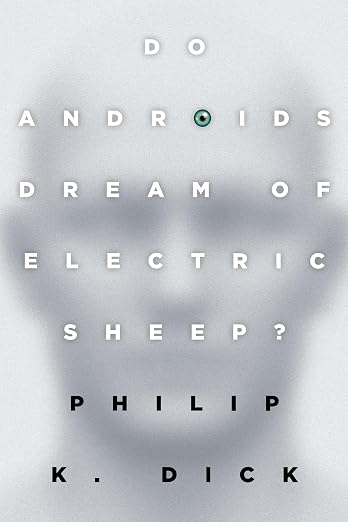
Do Androids Dream of Electric Sheep
Philip K. Dick
1968
A science-fiction novel about artificial beings, empathy, identity, and the uncertain boundary between human and machine
Published in 1968, Do Androids Dream of Electric Sheep? takes a place in a post-apocalyptic future where Earth has been devastated by war and much of its population has migrated to off-world colonies. Human-made androids have become increasingly sophisticated, creating a need to distinguish artificial beings from the humans they resemble.
At the center of the novel is the question of empathy. The ability to recognise and respond to the experience of another becomes one of the ways society attempts to distinguish humans from androids. Yet as the story unfolds, that distinction becomes increasingly difficult to maintain.
Dick is less interested in imagining a future filled with intelligent machines that in using artificial beings to question our assumptions about humanity itself. What makes someone human? Is it intelligence, memory, emotion, empathy, biological origin, or something else entirely? And if a machine can convincingly imitate the qualities we associate with humanity, what does that reveal about the qualities themselves?
This makes the novel particularly relevant to DCRU. As technology increasingly produces systems capable of imitating language, creativity, reasoning, personality, and other forms of human expression, the boundary between the human and the artificial becomes a question worth examining rather than simply assuming.
Do Androids Dream of Electric Sheep is included in the DCRU library not because it predicted artificial intelligence, but because it provides a powerful fictional framework for examining identity, artificiality, empathy, and the meaning of being human in a technological society.
The machine may be the subject of the test. But perhaps the test is really for us.